
Summit night is the part of Kilimanjaro everyone talks about—and the part that is easiest to misunderstand from photographs. You usually begin in darkness after only a few hours of rest, climb slowly for hours in severe cold and thin air, reach the crater rim near dawn, continue toward Uhuru Peak if conditions and health allow, and then descend for much of the day.
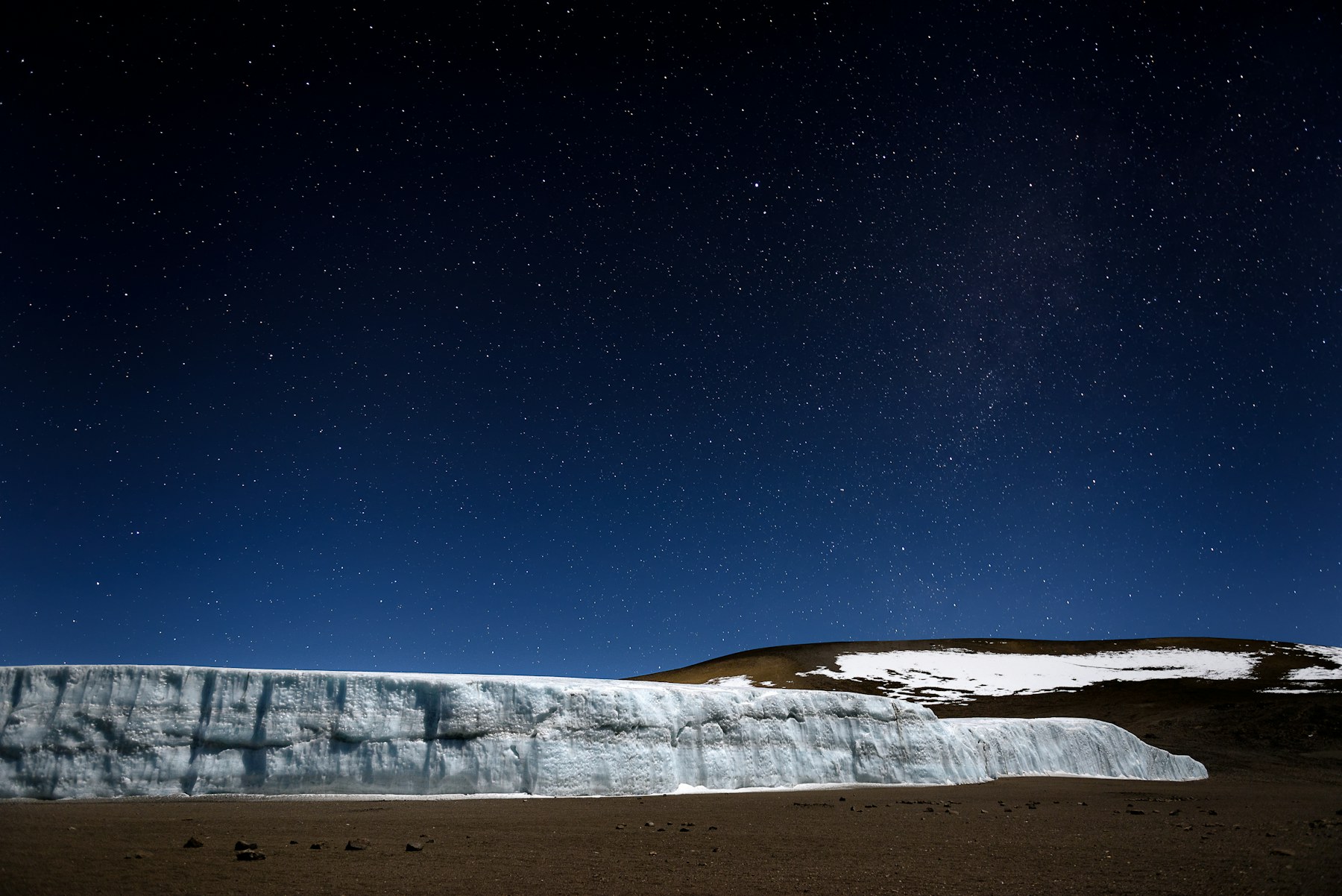
The Hours Before Departure
On most routes, the day before the summit is intentionally structured around reaching a high camp, eating, preparing equipment, and trying to rest. Depending on route, you may stage from Barafu, Kibo Hut, School Hut, or another high camp. Exact elevations and timing vary by itinerary.
Do as much preparation as possible before lying down. Lay out every clothing layer. Fill water. Put spare batteries somewhere warm. Decide where snacks, sunglasses, medication, and camera are going. Adjust trekking poles. Confirm headlamp operation. The more decisions you remove from the midnight routine, the calmer the start becomes.
When Do You Start?
Many summit attempts begin around midnight, but departures can be earlier or later based on route, group pace, weather, and operator strategy. A common pattern is a late-evening wake-up, light food and hot drink, then departure sometime before or around midnight.
The goal is to reach the crater rim around sunrise or shortly afterward while leaving enough time to continue to Uhuru Peak and descend safely. Your guide controls the schedule. Do not build your expectations around a specific social-media timestamp.
What the Pace Feels Like
Slow. Very slow.
At sea level, the pace may feel almost comical. At 5,000 meters, it makes sense. The guide is trying to keep the group moving steadily without burning energy. The rhythm is often a small step, pole placement, breath, repeat. Passing other groups proves very little. The objective is still many hours away.
This is where pole pole becomes more than a phrase. The strongest low-altitude hiker can sabotage the day by pushing too hard early.
Cold Management
Summit conditions can be brutally cold, especially with wind. You may leave camp wearing nearly your full system and still adjust layers as you climb. The challenge is balancing warmth against sweat. Becoming soaked inside your insulation during an early climb can make later cold much harder to manage.
Typical summit systems include thermal base layers, fleece or active insulation, a substantial puffy jacket, shell, layered pants, warm socks, insulated gloves or mittens, warm hat or balaclava, and eye protection. Your exact system should be tested before Tanzania.
Read the Complete Kilimanjaro Packing List for a full summit-night checklist.
Eating and Drinking
People often lose appetite at altitude, but summit night requires energy. Eat the pre-departure meal or snack even if it is not appealing. Carry simple foods you have already used during training: bars, chews, candy, dried fruit, cookies, energy gels, or other easy carbohydrates.
Water can freeze. Hydration hoses are especially vulnerable because the narrow tube is exposed to cold. Many climbers rely more heavily on insulated bottles for the summit push. Store bottles in a way that reduces freezing and follow your guide’s recommendations.
The Darkness
One of the most striking parts of summit night is how little of the mountain you can see. Your world may shrink to the patch of ground illuminated by your headlamp and the string of lights above and below you.
That can be psychologically useful. Instead of staring at a distant objective that never seems to get closer, you focus on the next few steps. The mountain becomes rhythm.
The Mental Challenge
Summit night is uncomfortable by design. You are tired. It is dark. You may be cold. Your breathing is heavy at a pace that would be easy at home. Time feels distorted. The most useful mental strategy is to make the objective smaller.
- Get to the next guide break.
- Take ten more steady breaths.
- Eat one small snack.
- Keep hands warm.
- Do not think about the remaining descent yet.
At the same time, mental toughness does not mean ignoring danger signs. Confusion, loss of coordination, or breathlessness at rest require urgent attention. The Altitude and Acclimatization Guide explains the difference between expected discomfort and serious warning signs.
Stella Point and Gilman’s Point
Most climbers reach the crater rim at either Stella Point or Gilman’s Point, depending on the summit line. Southern routes commonly approach Stella Point. Marangu and Rongai commonly reach Gilman’s Point.
Reaching the rim is a major accomplishment. The landscape changes. The horizon opens. Sunrise may begin to illuminate Mawenzi and the plains below. But Uhuru Peak is still farther along the rim.
That final traverse surprises people. You may feel emotionally “done” when you reach the rim and then learn there is more climbing. Plan for that mentally.
Sunrise
If timing and weather cooperate, sunrise can be one of the most memorable moments of the climb. The sky begins changing long before the sun appears. Mawenzi can silhouette against the horizon. Glaciers and snow catch color. The plains below may remain hidden beneath cloud.
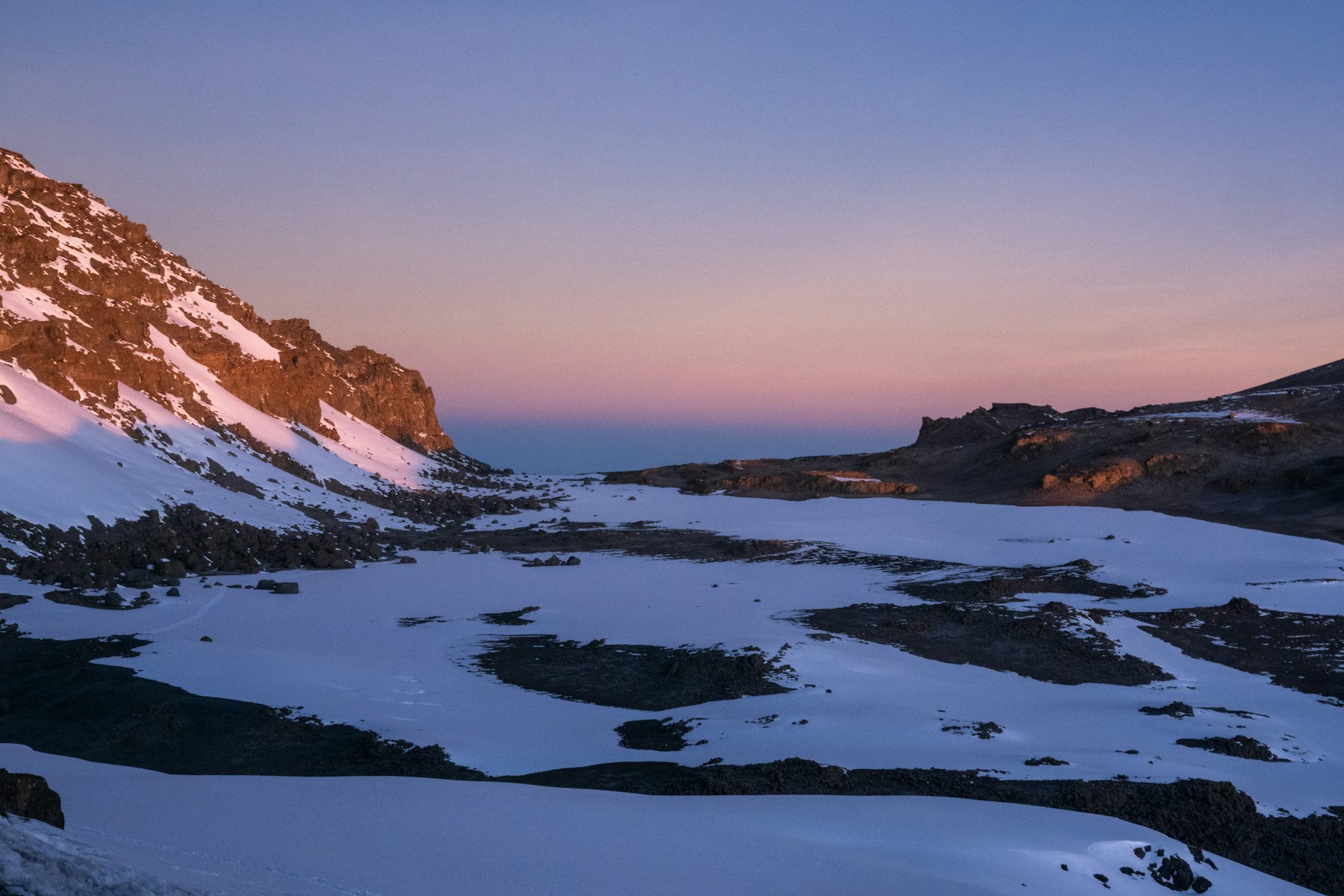
This is also the point when sunglasses often become necessary. UV exposure is intense at altitude, and snow or ice increases glare.
Uhuru Peak
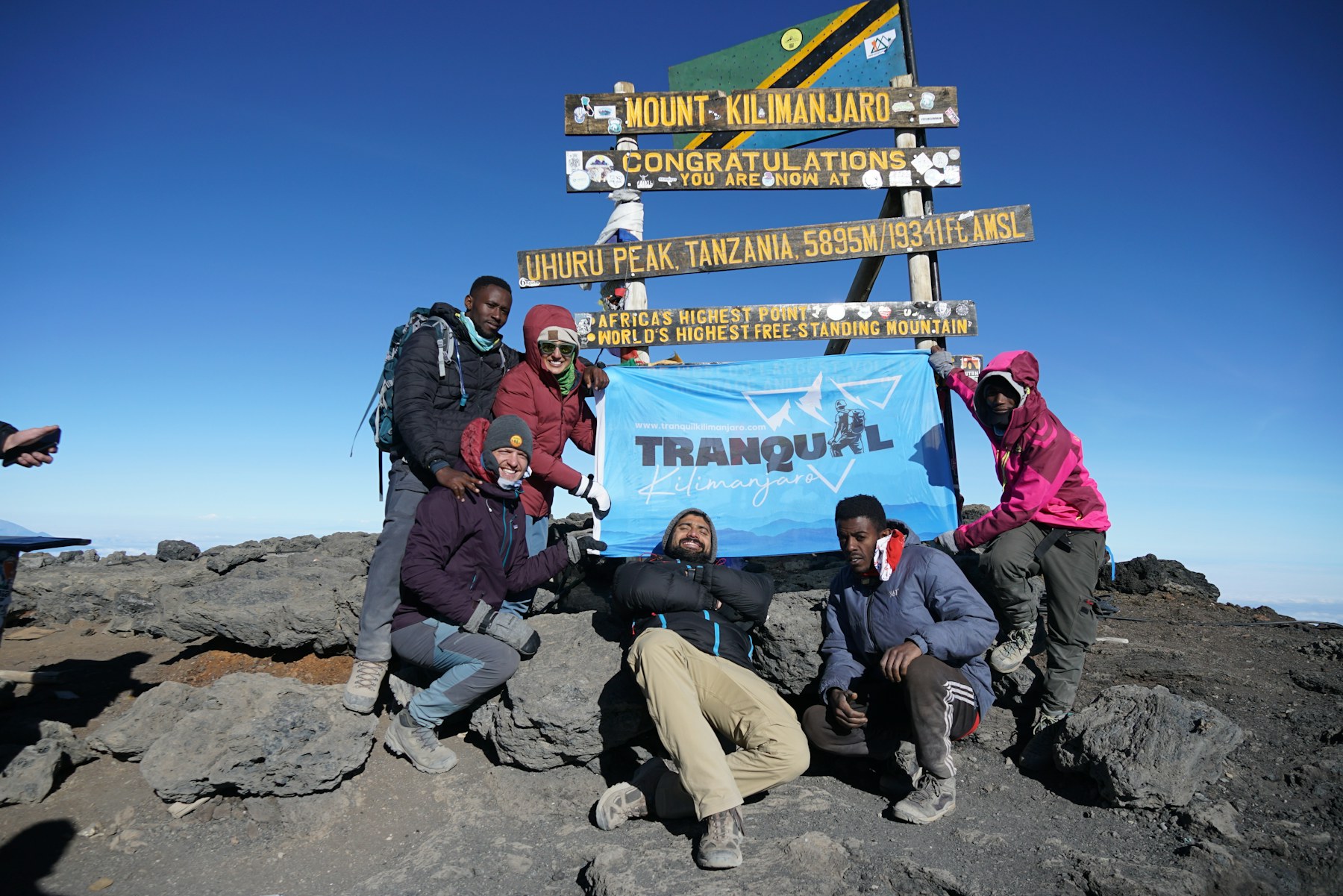
Uhuru Peak is Kilimanjaro’s highest point at 5,895 meters (19,341 feet). The famous summit sign makes the moment instantly recognizable, but do not let the photo become the only reason you are there.
At nearly 5,900 meters, most people do not want to linger for an extended photo session. Weather, symptoms, crowding, and guide instructions determine how long you stay. Take the photograph, look around, recognize what the team achieved—and prepare to descend.
The Descent Starts Immediately
The summit is only halfway through the day’s safety problem. You still have to get down. Descending loose volcanic scree can be fast but demanding. Legs that felt strong going up can begin shaking. Knees and toes take abuse. Trekking poles become extremely valuable.
Most itineraries return to the high camp for food and a short rest, then continue to a much lower camp the same day. That can make summit day exceptionally long. The reward is a dramatic increase in available oxygen as you descend.
Why Training the Descent Matters
Many training plans focus almost exclusively on uphill cardio. Summit day exposes that mistake. Your quadriceps need eccentric strength to control repeated downhill steps. Practice long descents, step-downs, and trekking-pole technique during training.
Our Kilimanjaro Training Guide specifically includes downhill preparation and back-to-back hiking days.
What If You Need to Turn Around?
Then you turn around.
That decision can be emotionally difficult after months of preparation, but the mountain is not a contract. Symptoms, weather, time, or guide judgment can end a summit attempt. Responsible climbers decide before the trip that safety decisions are legitimate outcomes.
A good operator also has enough guide coverage to split a group when necessary rather than forcing everyone to make the same medical decision.
What to Keep in Your Summit Daypack
- water protected from freezing;
- snacks that remain edible when cold;
- personal medications;
- headlamp and spare battery/power;
- sunglasses;
- sunscreen and lip protection;
- extra glove layer;
- shell layer if not already wearing it;
- camera or phone protected from cold;
- toilet supplies;
- small emergency/foot-care items according to operator guidance.
Summit-Night Mistakes to Avoid
Starting too fast. Energy spent early is expensive later.
Waiting until you are cold to add a layer. Manage temperature proactively.
Ignoring food because you are not hungry. Take in small amounts regularly.
Letting water freeze. Plan your system before departure.
Hiding symptoms. Tell the guide what is happening.
Using all your emotion on the crater rim. Uhuru and a long descent still remain.
Forgetting the descent in training. Strong uphill fitness is not enough.
What Summit Night Is Really About
It is tempting to frame summit night as a test of toughness. We think that misses the point. The better skill is discipline: walking slowly when you could walk faster, adding a layer before you are shivering, eating when you do not want food, admitting when something feels wrong, listening to the guide, and accepting that the summit does not outrank safety.
If everything goes well, you get the extraordinary reward: sunrise over Africa from the roof of the continent and the knowledge that you reached it one deliberately slow step at a time.
Sources and Planning References
- TANAPA — Kilimanjaro National Park
- TANAPA — Kilimanjaro Attractions
- CDC Yellow Book 2026 — High-Altitude Travel and Altitude Illness
2027 Kilimanjaro Adventure — Northern Circuit
Ready to turn the research into a real climb? See dates, route, pricing, inclusions, and availability.
View this trip