
Summit night reduced my entire world to a circle of headlamp light about six feet wide.
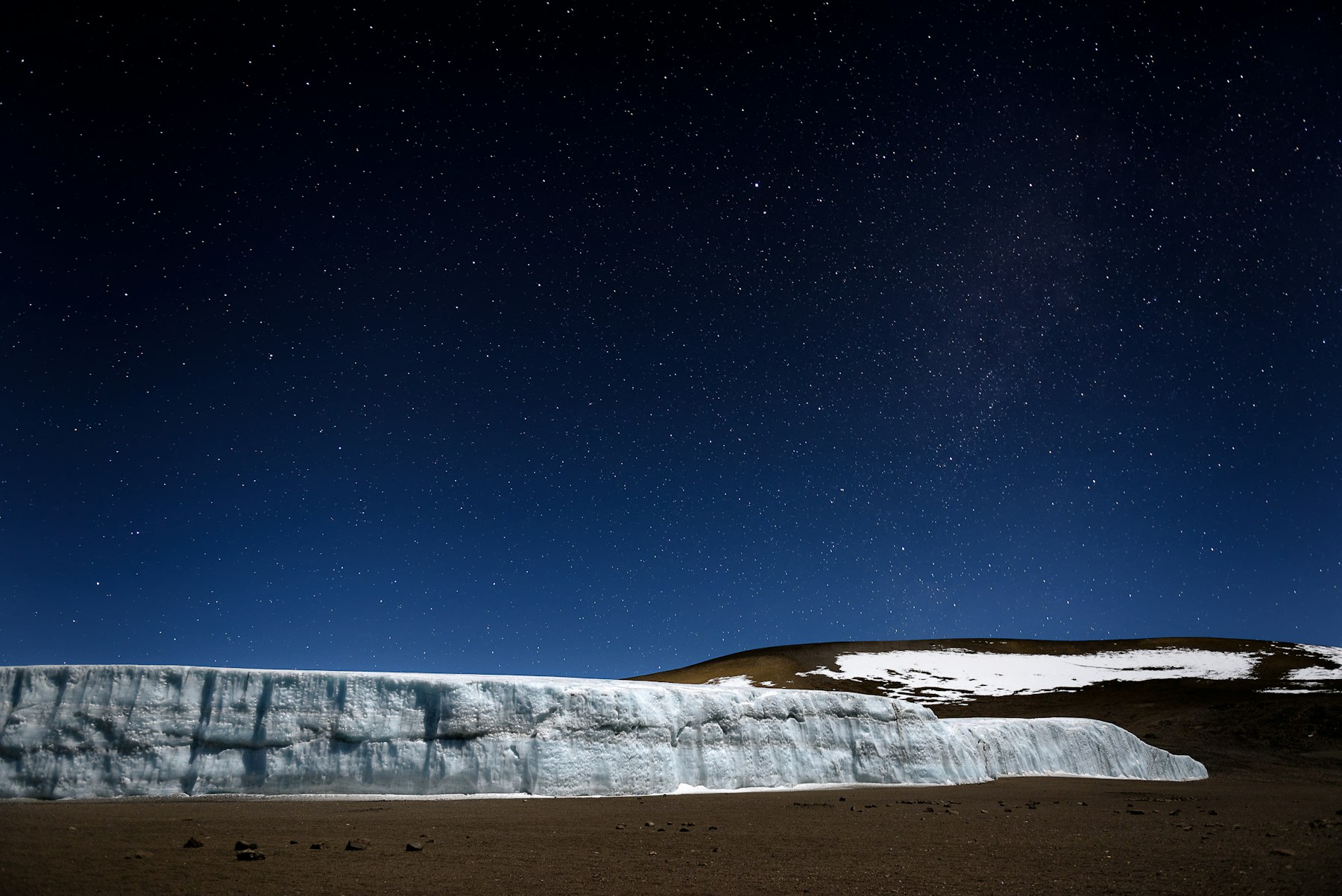
Everything outside that circle disappeared. There was no great mountain, no Tanzania, no Uhuru Peak and almost no sense of distance.
There were boots. Rock. Dust. The person ahead of me.
And the next step.
The Cold Arrived Slowly
We began before midnight. At first I felt warm inside all the layers we had staged at Kibo. Then the cold started finding gaps.
Fingers first.
Then toes.
I moved my hands inside the heavy gloves and flexed my fingers around the trekking-pole grips. David’s water insulation finally became important. My own bottle was still liquid, but the water near the cap had started to turn slushy.
At one break, Marcus tried to bite an energy chew and discovered it had transformed into a piece of climbing equipment.
“I think this is now a carabiner,” he said.
Nobody had enough breath to laugh properly, but we tried.
A Headlamp Problem at the Wrong Time
Several hours into the climb, Sarah’s headlamp began dimming. She had spare batteries, but changing them with thick gloves in the wind was another matter.
Ben and one of the guides helped. Ben held a light. Sarah pulled off an outer glove for less than a minute, swapped the batteries and immediately shoved her hand back inside.
The problem was minor. It also demonstrated why summit gear has to work when you are cold, tired and not thinking particularly quickly.
Everything is harder at altitude.
The Mountain Became Sound
The group grew quiet. Conversation cost energy. I heard breathing, poles, the crunch of scree and occasionally a guide singing softly somewhere ahead.
One of the songs had a steady rhythm that matched our steps.
I stopped looking at my watch. Time was not helping.
Knowing that three hours had passed did not tell me whether I could walk three more.
So I stopped asking.
Step.
Pole.
Breathe.
Repeat.
Hans Meyer Cave
We rested briefly near Hans Meyer Cave. Sitting felt wonderful for about twenty seconds. Then the cold found me.
Joseph pushed us gently to move again.
“Warm by walking,” he said.
He was right.
I ate half a chocolate bar that had become nearly solid and washed it down with warm-ish water. The combination was not delicious. It was fuel.
Dawn Changes Everything
Eventually the darkness began thinning.
Not sunrise yet—just enough light for the horizon to develop shape. Mawenzi appeared like an enormous jagged shadow.
That view gave me energy I did not know I still had.
Gilman’s Point became the only goal that mattered.
Not Uhuru.
Not the crater rim.
Gilman’s.
The final approach felt brutally slow. There was no hidden reserve of heroic strength waiting to emerge. My legs worked because I kept asking them to work.
When we reached Gilman’s Point, relief hit harder than triumph.
Sarah hugged Elena. Marcus bent forward over his trekking poles. David stood staring at the dawn.
I felt tears in my eyes and did not care whether they were emotion, cold or both.
We were on the crater rim at roughly 18,638 feet.
Then Joseph reminded us of the obvious.
Uhuru Peak was still ahead.
I looked along the rim and thought it seemed impossibly far.
Everything in me objected.
Then we started walking again.
That was summit night in the end—not one heroic effort, but hundreds of small decisions not to stop.
One headlamp at a time had gotten us through the darkness.
One step at a time would have to do the rest.
2027 Kilimanjaro Adventure — Northern Circuit
Ready to turn the research into a real climb? See dates, route, pricing, inclusions, and availability.
View this trip